⚠️
Pitfalls & Caveats in Using AI
 🔍
Information Gathering
🔍
Information Gathering
- Risk of oversimplification:
Summaries may omit nuance or context. Caveat: Always
skim the original source to confirm accuracy.
- Bias in trend detection: AI
may highlight themes based on frequency, not importance. Caveat:
Cross-check with editorial judgment.
📚 Research
- Outdated or incorrect context:
AI may provide timelines or explanations that miss recent
updates. Caveat: Verify dates and facts against
authoritative sources.
- Surface-level explanations:
Simplified breakdowns can gloss over complexities. Caveat:
Use AI as a starting point, not the final word.
✍️ Content Creation
- Generic headlines:
AI-generated headlines may lack originality or local nuance. Caveat:
Treat them as drafts, then refine with your own voice.
- Rigid outlines: AI structures
may not fit your narrative style. Caveat: Adjust
outlines to match the story’s flow and editorial standards.
🖋️ Editing
- Loss of tone: Proofreading
suggestions may strip away personality or intended style. Caveat:
Accept grammar fixes but preserve your unique voice.
- Over-simplification:
Readability rewrites can make serious topics sound too casual. Caveat:
Balance clarity with seriousness.
🎙️ Multimedia Support
- Transcription errors: AI may
mishear names, technical terms, or accents. Caveat:
Double-check key quotes before publishing.
- Translation inaccuracies:
Subtle cultural or political nuances may be lost. Caveat:
Verify sensitive translations with a native speaker if possible.
📊 Data & Verification
- False confidence: AI may
present analysis or fact-checks as definitive when they’re not.
Caveat: Always confirm with primary data sources
(official stats, peer-reviewed studies).
- Cherry-picking: AI may
highlight certain data points while ignoring others. Caveat:
Review the full data set yourself to avoid skewed reporting.
🧭 General Caveats Across All Prompts
- Hallucinations: AI can invent
facts, quotes, or sources.
- Bias: AI reflects biases in
its training data — watch for skewed perspectives.
- Over-reliance: Using AI as a
shortcut can erode investigative rigor.
- Confidentiality: Never feed
sensitive or unpublished material into AI tools without
considering privacy and security implications.
- Accountability: AI cannot
replace editorial responsibility — the journalist is always
accountable for accuracy.
✅ Bottom line: AI is a powerful
assistant, but it’s not a substitute for journalistic judgment,
verification, and ethical responsibility. Treat outputs as drafts,
leads, or aids — never as final copy.
AI/August 2026
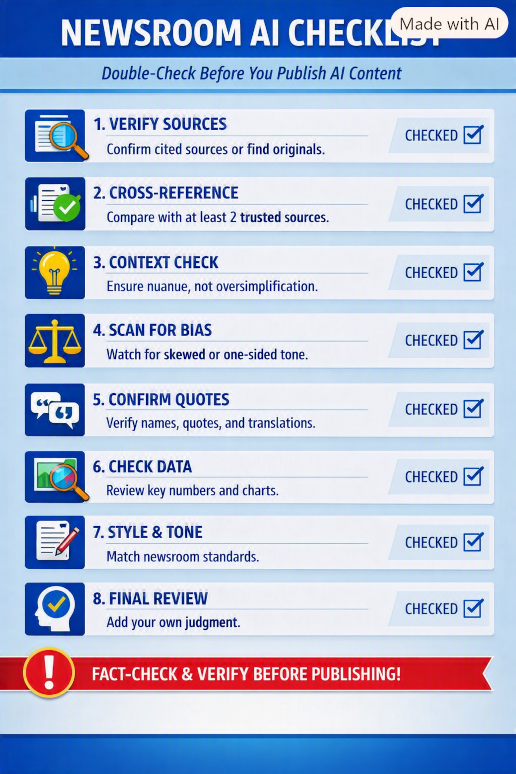
Note: In item 3 (Context
check for nuance) of the AI-generated infographic above,
the AI failed to spell the word nuance correctly despite
repeated instructions! Journalists will have to check every line
and image of infographic generated by AI. Sometimes infographics
will have to be corrected with a graphic editing tool.
For further reading:
Does
AI censor you?
Tips
for prompting AI
Journalist's
prompt formula guide
BACK